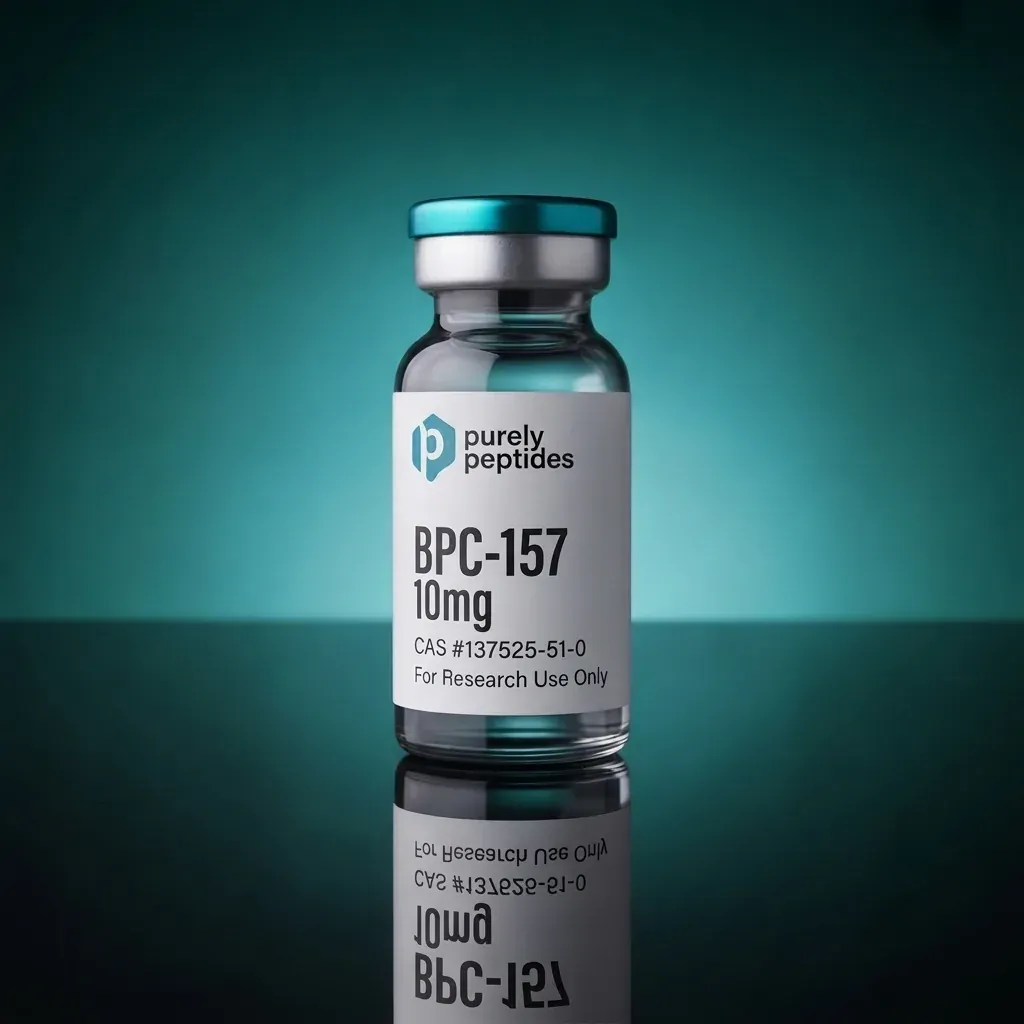
BPC-157 10mg
BPC-157 (Body Protection Compound-157) is a synthetic pentadecapeptide derived from a partial sequence of human gastric juice protein BPC. The 15-amino acid sequence (Gly-Glu-Pro-Pro-Pro-Gly-Lys-Pro-Ala-Asp-Asp-Ala-Gly-Leu-Val) has demonstrated remarkable stability in gastric acid, distinguishing it from most peptides. BPC-157 is widely studied in preclinical tissue-repair research, including tendon-healing and gastrointestinal models. Supplied strictly for in-vitro research and laboratory use only. Not for human or animal use.
Strength
Select Option
2+ save 5% · 5+ save 10% · 10+ save 20%
- Free Priority shipping on US orders over $100
- Ships same day on orders before 2 PM MST
- Plain, secure packaging
- Third-party tested — lot BPC-20260828-01 at 99.74% purity
Batch Tracking
Batch #
BPC-20260828-01
Tested
2026-09-08
Purity
99.74%
Method
RP-HPLC (214 nm)
Mechanism of Action
In isolated rat aorta, BPC-157 showed nitric oxide (NO)-dependent effects on vascular tone. The cited vascular review discusses VEGF-related pathways, but its abstract does not establish VEGF upregulation. In cultured rat Achilles tendon fibroblasts, BPC-157 increased FAK and paxillin phosphorylation and cell migration; that experiment did not measure wound closure.
Properties
CAS Number
137525-51-0
Molecular Formula
C₆₂H₉₈N₁₆O₂₂
Molecular Weight
1419.56 Da
Sequence
Gly-Glu-Pro-Pro-Pro-Gly-Lys-Pro-Ala-Asp-Asp-Ala-Gly-Leu-Val
Half-Life
Not established
Storage
Store lyophilized at -20°C. Reconstituted at 2-8°C, use within 14 days.
Shipping & Delivery
- Same-day dispatch on orders placed before 2 PM MST (Arizona — no daylight saving).
- US shipping from $5. Free Priority on orders $100+ (before discounts).
- Plain, unmarked packaging — no branding or product names on the outside.
- Ships to all 50 states, DC, Puerto Rico & the U.S. Virgin Islands; tracking emailed on every order.
Quality & Testing
- Independently tested by Bioviridian Inc. — identity by LC-MS/MS, purity by RP-HPLC (214 nm).
- Measured at 99.74% purity on lot BPC-20260828-01.
- USA-based; dispatched from Phoenix, Arizona.
- Supplied strictly for in-vitro laboratory research — not for human use.
Research Applications
References & Citations
(4)Modulatory effects of BPC 157 on vasomotor tone and the activation of Src-Caveolin-1-endothelial nitric oxide synthase pathway.
Hsieh MJ, Lee CH, Chueh HY, et al.
Stable gastric pentadecapeptide BPC 157-NO-system relation
Sikiric P, Seiwerth S, Rucman R, et al.
The promoting effect of pentadecapeptide BPC 157 on tendon healing involves tendon outgrowth, cell survival, and cell migration
Chang CH, Tsai WC, Lin MS, et al.
Other strengths
Research Use Only
This product is intended strictly for in-vitro research, educational, and laboratory use. Not for human consumption. The information provided is based on published research and does not constitute medical advice.