Lot certificates published
Plain, secure packaging
Catalog/GLOW
GLOW
#1041
Lyophilized Peptide

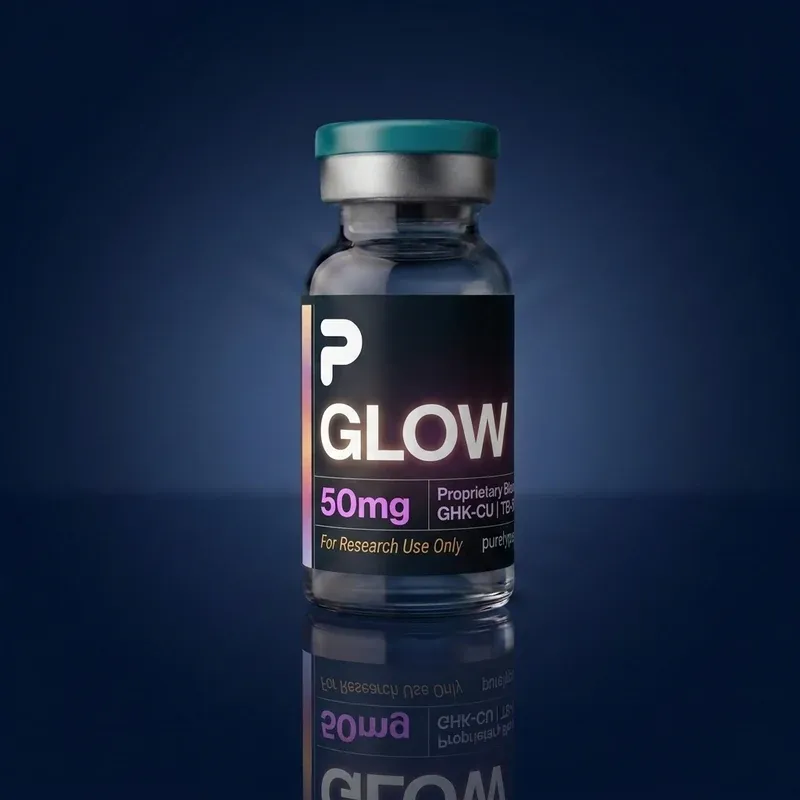
GLOW 50mg

GLOW is a proprietary peptide blend combining GHK-Cu (35mg), TB-500 (10mg), and BPC-157 (5mg) in a single 50mg lyophilized vial. Its components are individually studied in tissue-repair and extracellular-matrix research models. The cited papers concern individual compounds, not this combination; they do not establish complementary activity or synergy for the blend. This is a lower-total-mass companion to the 70mg GLOW listing, with a different component ratio. Supplied strictly for in-vitro research and laboratory use only. Not for human or animal use.

Select Option

Single (50mg)$109.99

2+ save 5% · 5+ save 10% · 10+ save 20%

Quantity

1
= $109.99
Buy now

Mechanism of Action

The cited evidence concerns individual compounds. Pickart et al. review increased collagen synthesis with GHK-Cu in rat wound models; this does not establish an effect of this blend. TB-500 is a short peptide fragment derived from the parent peptide thymosin beta-4; the thymosin beta-4 literature cited below characterises the parent peptide rather than the fragment. Malinda et al. studied full-length thymosin beta-4 in rat skin wounds and a keratinocyte migration assay. The BPC-157 review discusses NO-system relations in animal injury models; Chang et al. reported FAK/paxillin phosphorylation and migration in cultured rat Achilles tendon fibroblasts. None of these cited studies tested the combined formulation.

Properties

Component CAS Numbers

GHK-Cu 89030-95-5 · BPC-157 137525-51-0 · TB-500 885340-08-9

Storage

Store lyophilized at -20°C. Reconstituted at 2-8°C, use within 14 days.

Shipping & Delivery

  • Same-day dispatch on orders placed before 2 PM MST (Arizona — no daylight saving).
  • US shipping from $5. Free Priority on orders $100+ (before discounts).
  • Plain, unmarked packaging — no branding or product names on the outside.
  • Ships to all 50 states, DC, Puerto Rico & the U.S. Virgin Islands; tracking emailed on every order.
Full shipping details

Quality & Testing

  • No third-party certificate has been published for this compound yet.
  • USA-based; dispatched from Phoenix, Arizona.
  • Supplied strictly for in-vitro laboratory research — not for human use.

Certificates are published for each lot we have tested — see the 14 published so far.

Research Applications

1Review of individual-component research
2Component-specific evidence and model comparison
3Assessment of evidence gaps for the combined formulation

References & Citations

(4)
1

The promoting effect of pentadecapeptide BPC 157 on tendon healing involves tendon outgrowth, cell survival, and cell migration.

Chang CH, Tsai WC, Lin MS, et al.

J Appl Physiol (1985) (2011)PMID: 21030672 DOI
2

GHK Peptide as a Natural Modulator of Multiple Cellular Pathways in Skin Regeneration

Pickart L, Vasquez-Soltero JM, Margolina A.

BioMed Res Int (2015)PMID: 26236730 DOI
3

Thymosin beta4 accelerates wound healing

Malinda KM, Sidhu GS, Mani H, et al.

J Invest Dermatol (1999)PMID: 10469335 DOI
4

Stable gastric pentadecapeptide BPC 157-NO-system relation

Sikiric P, Seiwerth S, Rucman R, et al.

Curr Pharm Des (2014)PMID: 23755725 DOI

Other strengths

Research Use Only

This product is intended strictly for in-vitro research, educational, and laboratory use. Not for human consumption. The information provided is based on published research and does not constitute medical advice.

Research reference

The Library holds no record for this blend. Each component named on this listing has a published identity record; those records describe the individual compounds, not this combination.

More references from the Research Library (12)

Further papers cited in the Library's records for this blend's components, each checked against PubMed. They describe the individual compounds in research settings and are not statements about this product or this combination.

GHK-Cu (7)

From the GHK-Cu record.

  1. Structure of the Glycyl-L-histidyl-L-lysine--copper(II) complex in solution.

    Freedman JH, Pickart L, Weinstein B, et al.

    Biochemistry (1982)Chemical, structural or analytical; no biological modelPMID 6291585
  2. The interaction of copper(II) and glycyl-L-histidyl-L-lysine, a growth-modulating tripeptide from plasma.

    Lau SJ, Sarkar B

    The Biochemical journal (1981)In vitroPMID 7340824
  3. Ultrasensitive and Label-Free Detection of Copper Ions by GHK-Modified Asymmetric Nanochannels.

    An P, Zhang Z, Yang J, et al.

    Analytical chemistry (2023)Chemical, structural or analytical; no biological modelPMID 37624577
  4. Effects of glycyl-histidyl-lysyl chelated Cu(II) on ferritin dependent lipid peroxidation.

    Miller DM, DeSilva D, Pickart L, et al.

    Advances in experimental medicine and biology (1990)In vitroPMID 2244543
  5. The human tri-peptide GHK and tissue remodeling.

    Pickart L

    Journal of biomaterials science. Polymer edition (2008)Review articlePMID 18644225
  6. N.m.r. and e.p.r. investigation of the interaction of copper(II) and glycyl-L-histidyl-L-lysine, a growth-modulating tripeptide from plasma.

    Laussac JP, Haran R, Sarkar B

    The Biochemical journal (1983)Chemical, structural or analytical; no biological modelPMID 6303307
  7. SPARC is a source of copper-binding peptides that stimulate angiogenesis.

    Lane TF, Iruela-Arispe ML, Johnson RS, et al.

    The Journal of cell biology (1994)In vitro · In vivo (subject not stated)PMID 7514608

TB-500 (3)

From the TB-500 record.

  1. Synthesis and characterization of the N-terminal acetylated 17-23 fragment of thymosin beta 4 identified in TB-500, a product suspected to possess doping potential.

    Esposito S, Deventer K, Goeman J, et al.

    Drug testing and analysis (2012)Chemical, structural or analytical; no biological modelPMID 22962027
  2. Doping control analysis of TB-500, a synthetic version of an active region of thymosin β₄, in equine urine and plasma by liquid chromatography-mass spectrometry.

    Ho EN, Kwok WH, Lau MY, et al.

    Journal of chromatography. A (2012)In vitro · AnimalPMID 23084823
  3. TB500/TB1000 and SGF1000: A scientific approach for a better understanding of misbranded and adulterated drugs.

    Delcourt V, Garcia P, Chabot B, et al.

    Drug testing and analysis (2022)Chemical, structural or analytical; no biological modelPMID 36482504

BPC-157 (2)

From the BPC-157 record.

  1. Gastric pentadecapeptide body protection compound BPC 157 and its role in accelerating musculoskeletal soft tissue healing.

    Gwyer D, Wragg NM, Wilson SL

    Cell and tissue research (2019)Review articlePMID 30915550
  2. Stable Gastric Pentadecapeptide BPC 157 and Wound Healing.

    Seiwerth S, Milavic M, Vukojevic J, et al.

    Frontiers in pharmacology (2021)Review articlePMID 34267654